
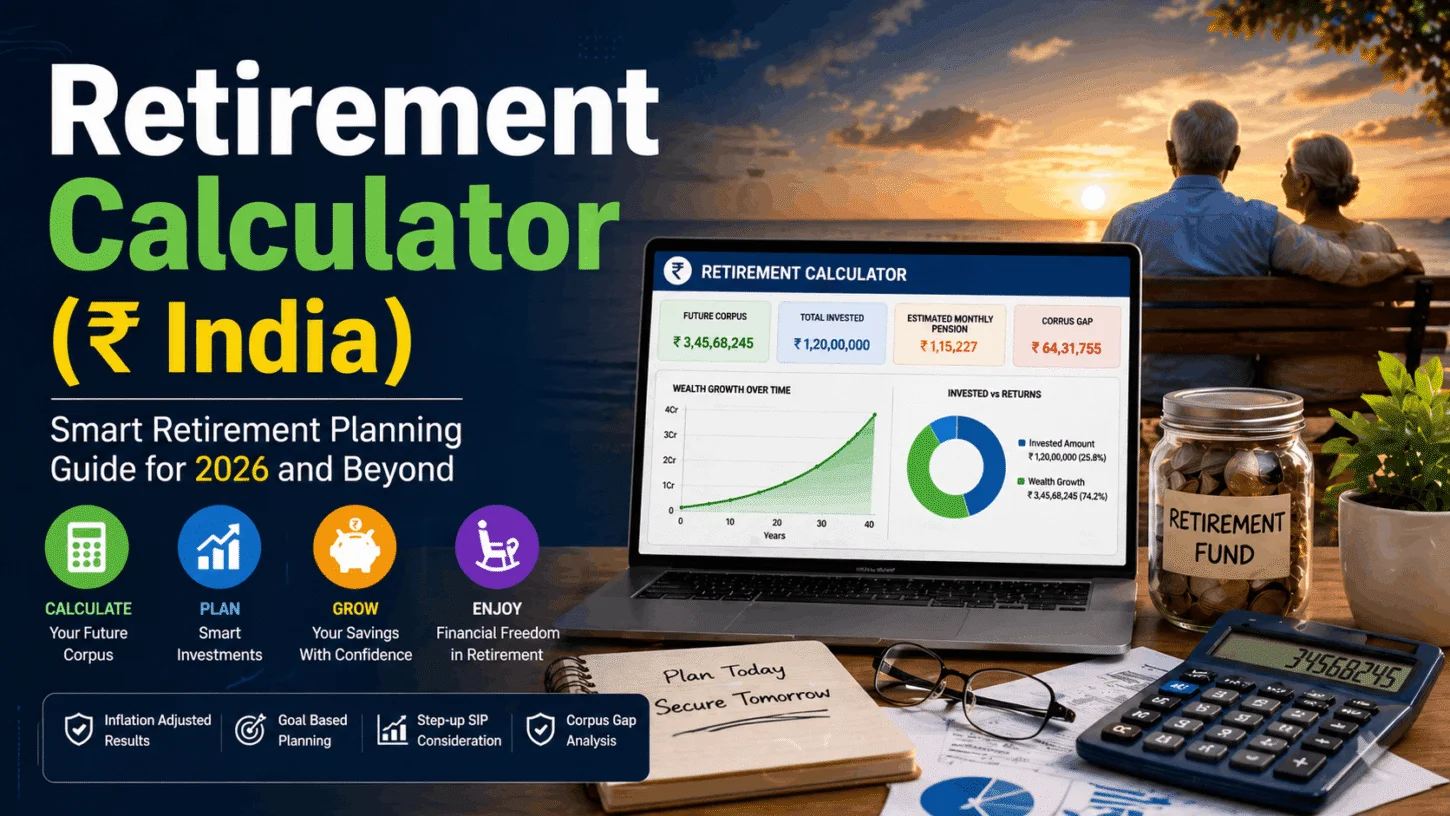
💰 Retirement Calculator India (Advanced Planner)
Invested Amount: ₹ 0
Future Corpus: ₹ 0
Inflation Adjusted Corpus: ₹ 0
Required Corpus: ₹ 0
Corpus Gap: ₹ 0
Estimated Monthly Pension: ₹ 0
Yearly Growth Breakdown
| Year | Invested | Value | Inflation Value |
|---|
Retirement Calculator Online India: Simple Retirement Planning Guide for 2026 and Beyond
Planning for retirement is easier when you have a clear idea about your future expenses, savings and investments. A Retirement Calculator can help you estimate how much money you may need after retirement and how much you may need to invest today.
Retirement planning is not only for people who are close to retirement. Starting early gives you more time to save, invest and adjust your plan when your income or expenses change.
This Retirement Calculator Online India guide explains how the calculator works, which numbers you need, why inflation matters and how you can use the result for long-term financial planning.
What Is a Retirement Calculator?
A Retirement Calculator is an online financial planning tool that estimates your future retirement needs using information such as your current age, retirement age, current expenses, monthly investment, expected return and inflation.
The calculator does not know exactly what will happen in the future. Instead, it uses the numbers you enter to create an estimate.
This can make retirement planning easier because you can change the inputs and see how different assumptions affect your estimated retirement corpus.
A retirement calculator can be useful for salaried employees, business owners, self-employed people and investors who want to plan their long-term finances.
Why Retirement Planning Is Important
Retirement can last for many years. Even after regular employment income stops, expenses such as food, housing, healthcare, insurance, travel and family needs may continue.
Inflation can also increase the cost of these expenses over time. An amount that looks sufficient today may not have the same purchasing power many years from now.
This is why retirement planning should consider both your future expenses and the growth of your investments.
A Retirement Calculator India can help you identify a possible gap between the amount you may need and the amount you are currently saving.
How Does a Retirement Calculator Work?
A retirement calculator uses several inputs to estimate a possible future retirement corpus.
- Current age
- Expected retirement age
- Current monthly or annual expenses
- Current savings and investments
- Monthly investment or SIP
- Expected rate of return
- Expected inflation rate
- Expected years in retirement
The calculator processes these values and provides an estimated figure. The exact inputs available can vary from one retirement calculator to another.
The important point is that the result depends on the assumptions you enter. If your expenses, investment return or inflation rate changes, the estimated retirement corpus can also change.
How to Use Retirement Calculator Online
Using a Retirement Calculator Online is simple. Before calculating, keep your current financial information ready.
- Enter your current age.
- Enter the age at which you expect to retire.
- Enter your current monthly or yearly expenses if the calculator asks for them.
- Enter your existing savings or investments, if the calculator provides this option.
- Enter the amount you currently invest every month.
- Enter your expected investment return as a planning assumption.
- Enter an inflation rate to understand how future expenses may increase.
- Enter the expected number of years you may need your retirement money.
- Check all the numbers before calculating.
- Click the calculate button to see the estimated retirement corpus.
- Change one input at a time to understand how the result changes.
- Review the result regularly as your income, expenses, investments and retirement plans change.
What Is Retirement Corpus?
A retirement corpus is the amount of money and investments you may have available to support your financial needs during retirement.
The required corpus is different for every person. Someone with lower expenses may need less money than someone with a higher lifestyle or larger family responsibilities.
The calculation can also depend on how long you expect the retirement corpus to last, inflation, investment returns and other sources of income.
Therefore, there is no single retirement corpus amount that is suitable for everyone.
Why Inflation Matters in Retirement Planning
Inflation is one of the most important factors in long-term retirement planning.
For example, if something costs ₹50,000 per month today, the same lifestyle may cost considerably more in the future because prices can rise over time.
This means simply looking at today’s expenses is not enough. A retirement plan should consider the possible increase in future expenses.
This is one of the main reasons an inflation-adjusted retirement calculator can be useful.
The Power of Starting Early
Starting retirement investments early gives your money more time to grow.
Compounding means that returns can generate further returns when the money remains invested. Over a long period, even regular investments can potentially grow into a larger corpus.
For example, a person who starts investing at a younger age has more years to make contributions and allow the investment to compound.
This does not mean that people who start late cannot build a retirement fund. It simply means that the required savings rate may be different.
Step-Up SIP and Retirement Planning
A step-up SIP means increasing the investment amount periodically, usually as income increases.
For example, an investor may start with a monthly investment of ₹10,000 and increase the amount gradually as salary or business income grows.
A higher investment amount over time can change the estimated retirement corpus significantly.
If your retirement calculator has a step-up option, you can use it to compare a fixed monthly investment with a gradually increasing investment.
How Much Money Do You Need for Retirement?
There is no universal retirement corpus that works for everyone.
Your retirement requirement depends on your current lifestyle, future expenses, retirement age, expected inflation, healthcare needs, family responsibilities, investments and other sources of income.
For example, a person planning to retire at 50 may need a different corpus from someone planning to retire at 60.
Similarly, someone who expects rental income, pension or other regular income may have different retirement needs from someone who depends entirely on investments.
Retirement Planning for Salaried Employees
Salaried employees can use a retirement calculator to understand whether their current savings and investments are moving toward their long-term goal.
Salary increases, bonuses and career changes can affect how much you are able to invest.
Instead of keeping the same investment amount for many years, you can review your plan whenever your income changes.
Retirement planning can also include employer-related retirement benefits and other long-term savings, depending on your situation.
Retirement Planning for Business Owners and Self-Employed People
Business owners and self-employed professionals may have less predictable monthly income than salaried employees.
For them, retirement planning can be especially useful because personal retirement savings may need to be built separately from business assets.
A calculator can help create different scenarios based on conservative and higher investment contributions.
It is also important to keep personal retirement savings separate from money required for business operations.
What Return Should You Enter in a Retirement Calculator?
The expected return is one of the most important assumptions in a retirement calculator.
There is no single return rate that can be guaranteed for the future. Different investments have different levels of risk and returns can vary from year to year.
Instead of assuming a very high return, it can be useful to test more than one scenario and see how the retirement corpus changes.
For example, you can compare a lower-return scenario with a moderate-return scenario. This gives you a better understanding of how sensitive your retirement plan is to investment performance.
Retirement Calculator and Monthly Pension Planning
Many people want to know not only how large their retirement corpus should be, but also how much monthly income they may need after retirement.
Your future retirement income may come from several sources, depending on your situation.
- Retirement savings
- Investment income
- Pension
- Rental income
- Dividend income
- Other regular income sources
A retirement calculator can help you compare your expected expenses with the income sources you expect to have after retirement.
Retirement Planning and Dividend Income
Some investors consider dividend-paying investments as one possible source of income during retirement.
Dividend income can change over time, so it should not automatically be treated as a fixed or guaranteed pension.
If you are researching dividend income, you can also use the StockRadiance Dividend Calendar to track dividend-related information.
👉 Read this: StockRadiance Dividend Calendar – Track Dividend Information
Factors That Can Change Your Retirement Plan
- Inflation and rising living costs
- Investment returns
- Changes in monthly income
- Changes in monthly expenses
- Retirement age
- Healthcare and medical expenses
- Family responsibilities
- Life expectancy
- Changes in investment contributions
- Unexpected financial requirements
Because these factors can change, retirement planning should be reviewed from time to time rather than calculated only once.
Common Retirement Planning Mistakes
A retirement calculator is useful, but the quality of the result depends on the assumptions you enter.
- Starting retirement planning too late.
- Ignoring inflation.
- Underestimating future expenses.
- Assuming very high investment returns.
- Not increasing investments when income increases.
- Depending on only one source of retirement income.
- Ignoring healthcare and emergency expenses.
- Not reviewing the retirement plan regularly.
- Keeping retirement money concentrated in a single investment.
How to Improve Your Retirement Plan
A retirement plan does not need to be complicated. Small improvements made consistently can make the plan easier to manage.
- Start investing as early as possible.
- Set a realistic retirement age.
- Track your monthly expenses.
- Review your savings rate regularly.
- Increase investments when your income increases.
- Consider inflation when estimating future expenses.
- Review your investment mix according to your risk tolerance and time horizon.
- Keep an emergency fund separate from retirement money.
- Review the plan at least once a year.
Why Use a Retirement Calculator in 2026?
Retirement planning is a long-term process. The earlier you understand your numbers, the more time you have to make changes.
A Retirement Calculator 2026 can help you test different assumptions about savings, inflation, returns and retirement age.
The calculator should not be viewed as a prediction of the future. Its main purpose is to help you understand possible scenarios and identify areas that may need attention.
Review Your Retirement Plan Regularly
Your financial situation can change over the years. Your salary may increase, your expenses may change, your family responsibilities may grow and your investment strategy may also change.
Because of this, the retirement calculation you make today may not remain suitable forever.
Reviewing your retirement plan regularly allows you to update your assumptions and adjust your savings or investment contributions when required.
Useful StockRadiance Financial and Market Tools
Retirement planning is connected with saving, investing and understanding the financial markets. You can explore these StockRadiance resources for additional information.
👉 Read this: StockRadiance Home – Market Research and Financial Tools
👉 Read this: Dividend Calendar – Track Dividend Information
👉 Read this: Technical Analysis – Study Stock Price Trends
👉 Read this: Stock Radar Tool – Explore Indian Stocks
👉 Read this: Top 50 Stocks – Explore Popular Indian Stocks
👉 Read this: Sector Dashboard – Explore Indian Market Sectors
👉 Read this: GIFT NIFTY Live – Track Pre-Market Market Signals
👉 Read this: Radiance AI Bot – Explore Stock Market Research
👉 Read this: Finance Tools – Explore More Financial Calculators
Useful External Financial Resources
For financial education and official information, it is useful to check reliable sources in addition to calculator estimates.
👉 Read this: Reserve Bank of India – Official Financial Information
👉 Read this: SEBI – Investor and Securities Market Information
👉 Read this: NSE India – Stock Market Information
👉 Read this: BSE India – Market and Company Information
👉 Read this: Investopedia – Financial Education Resources
Frequently Asked Questions: Retirement Calculator Online India
Final Thoughts: Retirement Calculator Online India
A Retirement Calculator is more than a simple mathematical tool. It can help you understand your future financial needs and see how today’s savings and investments may affect your retirement planning.
The most useful approach is to review your numbers regularly. If your income increases, you may be able to increase your investments. If your expenses change, you can update your retirement calculation.
Remember that calculator results are estimates, not guarantees. Use them as a planning guide and combine them with your own research and financial goals.
Disclaimer
This content and calculator are provided for educational and informational purposes only. Calculator results are estimates based on the information and assumptions entered by the user. Actual investment returns, inflation, expenses and future financial conditions may be different.
StockRadiance is not a SEBI-registered investment adviser. Please do your own research and consider speaking with a qualified financial professional before making investment or retirement-planning decisions.
👉 Read this: StockRadiance Legal Disclaimer
Contents
- 1. 💰 Retirement Calculator India (Advanced Planner)
- 2. Retirement Calculator Online India: Simple Retirement Planning Guide for 2026 and Beyond
- 3. What Is a Retirement Calculator?
- 4. Why Retirement Planning Is Important
- 5. How Does a Retirement Calculator Work?
- 6. How to Use Retirement Calculator Online
- 7. What Is Retirement Corpus?
- 8. Why Inflation Matters in Retirement Planning
- 9. The Power of Starting Early
- 10. Step-Up SIP and Retirement Planning
- 11. How Much Money Do You Need for Retirement?
- 12. Retirement Planning for Salaried Employees
- 13. Retirement Planning for Business Owners and Self-Employed People
- 14. What Return Should You Enter in a Retirement Calculator?
- 15. Retirement Calculator and Monthly Pension Planning
- 16. Retirement Planning and Dividend Income
- 17. Factors That Can Change Your Retirement Plan
- 18. Common Retirement Planning Mistakes
- 19. How to Improve Your Retirement Plan
- 20. Why Use a Retirement Calculator in 2026?
- 21. Review Your Retirement Plan Regularly
- 22. Useful StockRadiance Financial and Market Tools
- 23. Useful External Financial Resources
- 24. Final Thoughts: Retirement Calculator Online India


