
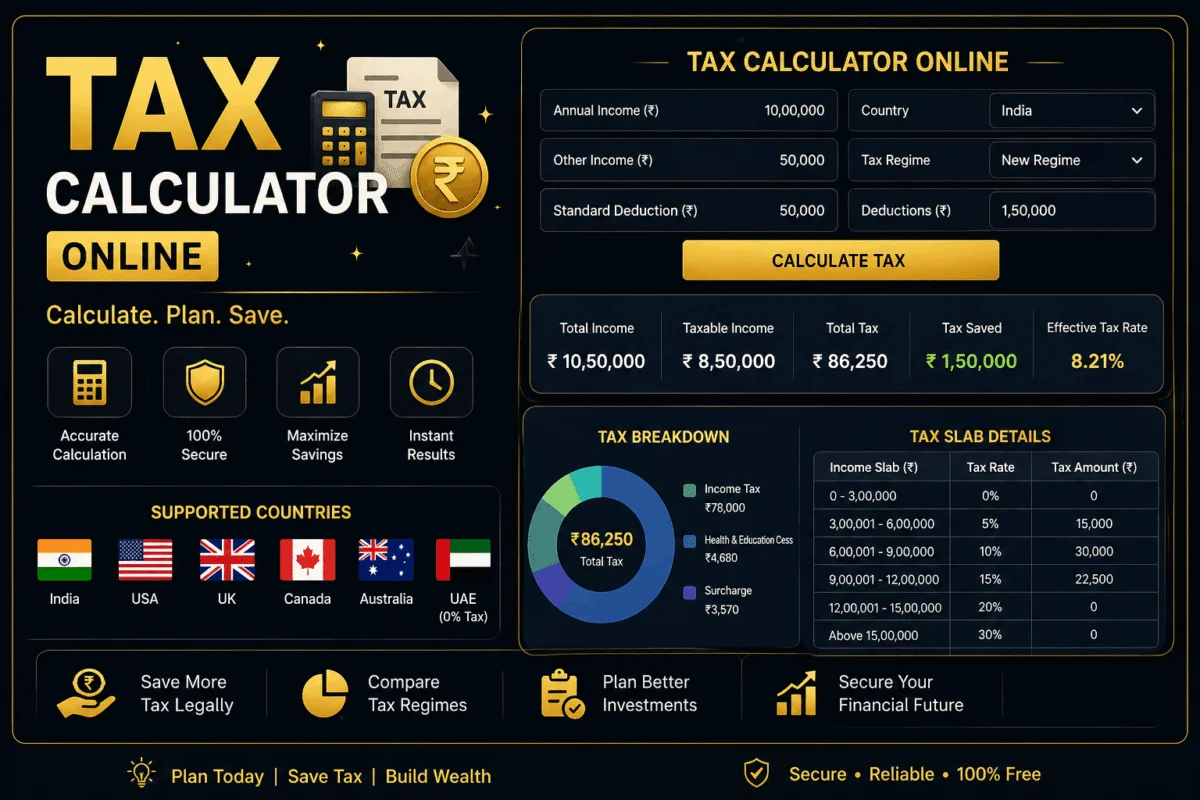
💸 Advanced Tax Calculator (India + Global)
Total Income: ₹ 0
Tax Payable: ₹ 0
Effective Tax Rate: 0%
Tax Saved: ₹ 0
Tax Slab Breakdown
| Slab | Rate | Tax |
|---|
Tax Calculator Online 2026: Simple Guide to Calculate Income Tax
Planning your income tax does not have to be difficult. A tax calculator online can help you get a quick estimate of your tax based on your income, deductions and selected tax regime.
This income tax calculator 2026 guide is written in simple language so that salaried employees, freelancers, business owners and investors can understand the basic tax calculation process without dealing with complicated terms.
A tax calculator is mainly useful for planning. You can enter your income details, check the estimated tax and understand how your tax position may change when your income or eligible deductions change.
The result should be treated as an estimate. Your final tax liability can depend on the type of income, deductions, exemptions, age, residential status, capital gains and other applicable tax rules.
What Is a Tax Calculator Online?
A tax calculator online is a simple financial tool that helps you estimate income tax from the information you enter.
For example, if you earn money from salary, business, freelance work, interest or investments, the calculator can help you understand the possible tax impact. Instead of doing every calculation manually, you can use an income tax calculator to get a quick estimate.
The main purpose is not only to see a tax number. It is also to help you understand your taxable income and plan your finances before filing your income tax return.
Why Use an Income Tax Calculator in 2026?
Tax rules can change from time to time. This is why checking your tax calculation before filing your return can be useful.
- It gives a quick estimate of your income tax.
- It reduces the need for manual calculations.
- It helps you understand taxable income.
- It can help you compare available tax regimes.
- It makes tax planning easier.
- It can help you check the effect of eligible deductions.
- It is useful when your income changes during the year.
For the latest applicable rules, always verify the result with the official Income Tax Department website.
How to Use the Tax Calculator Online
Using a tax calculator is usually simple. Follow these steps and enter your information carefully.
Enter your annual income: Start with your expected income for the relevant financial year.
Check your salary income: If you are salaried, use the income figure applicable to the calculator rather than simply entering your monthly salary.
Add other income: Include applicable income such as interest, rent, freelance income or other taxable income when required.
Enter eligible deductions: Add deductions only when you are eligible to claim them under the selected tax regime.
Check your age: Age can matter for certain tax calculations and rules.
Select the tax regime: Choose the applicable tax regime available to you.
Review your numbers: Check that the income and deduction figures are entered correctly.
Click Calculate: Use the calculator button to generate the estimated result.
Check taxable income: Look at the taxable income shown by the calculator.
Check estimated tax: Review the estimated income tax amount.
Compare your planning options: If the calculator supports comparison, check how different eligible deductions or regimes affect the result.
Verify before filing: Use the official Income Tax Department information and your tax documents before submitting your final return.
How Does an Income Tax Calculator Work?
The basic idea is simple. The calculator takes the income and other information you provide and applies the relevant calculation method.
A simplified way to understand the calculation is:
Total taxable income = Applicable income − Eligible deductions/exemptions, where applicable
The exact calculation can be more detailed because different types of income can have different tax treatment. Capital gains, special-rate income and other specific income categories may not always follow the same calculation as normal slab-rate income.
That is why an online calculator should be used as a planning and estimation tool rather than as a replacement for your tax return documents or professional tax advice.
Simple Tax Calculation Example
Suppose a person has an annual income of ₹10,00,000.
If the person has eligible deductions or other adjustments, the taxable income may be different from the total income. The final tax will then depend on the applicable tax regime and the nature of the income.
This is why simply applying one percentage to your complete salary is not the correct way to calculate income tax.
A tax calculator India tool can make this process easier by applying the relevant calculation steps to the information entered by the user.
New Tax Regime and Old Tax Regime
One of the most common questions people have while using an income tax calculator 2026 is which tax regime they should check.
For eligible individual taxpayers, the new tax regime is the default regime, while eligible taxpayers may have an option to choose the old tax regime subject to the applicable rules. The old regime generally provides access to more deductions and exemptions, while the new regime uses different slab rates and has fewer deductions and exemptions.
The Income Tax Department provides the applicable slab information and rules for AY 2026-27. You should check the official information before making your final tax calculation.
Read the official Income Tax Department information for AY 2026-27
What Is Taxable Income?
Taxable income is the income considered for tax calculation after applying the relevant deductions, exemptions and rules that are available to the taxpayer.
Your total income and taxable income are therefore not always the same.
For example, a person may have salary income along with interest income and other income. Depending on the applicable rules, some deductions or adjustments may reduce the amount considered for tax calculation.
Understanding this difference is important when using an online tax calculator.
Tax Calculator for Salaried Employees
Salaried employees are among the most common users of an income tax calculator.
Salary income can include different components, and the final tax calculation may depend on the applicable exemptions, deductions and tax regime.
Before using the calculator, keep your salary information, Form 16 and other relevant income details ready. This can make the calculation more useful and reduce the chance of entering incorrect numbers.
Tax Calculator for Freelancers and Business Owners
A tax calculator can also be useful for freelancers and people who earn income from business or professional activities.
However, business and professional income can involve additional rules. Expenses, presumptive taxation, accounting method and other tax provisions may affect the final calculation.
If your income situation is complex, do not rely only on a basic calculator. Verify the calculation with the applicable Income Tax Department rules or a qualified tax professional.
Tax on Investment Income
People who invest in stocks, mutual funds, fixed deposits and other financial products may have income apart from salary.
Interest income, dividends and capital gains may have different tax treatment. Therefore, you should not simply add every type of investment return and apply the same tax rate.
For dividend-related information, you can also explore the
StockRadiance Dividend Calendar
.
For stock-related research and market information, visit the
StockRadiance Technical Analysis
page.
How Tax Planning Can Help
Tax planning does not mean avoiding tax. It means understanding the applicable rules and using eligible deductions, exemptions and investment options in a planned way.
A tax calculator can help you see how your estimated tax changes when your income or eligible deductions change.
For example, before making a financial decision only for tax saving, consider the complete picture. The investment should also match your financial goals, risk level, time period and liquidity needs.
Things to Check Before Using a Tax Calculator
- Use the correct financial year or assessment year.
- Enter annual figures correctly.
- Do not confuse gross salary with taxable income.
- Include other taxable income where applicable.
- Do not enter deductions that you are not eligible to claim.
- Check whether the selected tax regime allows the deduction.
- Keep Form 16 and other income documents ready.
- Check interest and dividend income when applicable.
- Check capital gains separately where required.
- Verify the final result using official tax information.
Common Mistakes When Calculating Income Tax
- Using the wrong year: Tax rules can change, so check the relevant year.
- Entering monthly income as annual income: This can produce a completely different result.
- Ignoring other income: Interest, rent and other income may need to be considered.
- Adding every deduction: Only eligible deductions should be included.
- Ignoring investment income: Dividends and capital gains may need separate consideration.
- Assuming the calculator is the final answer: An online calculator normally gives an estimate.
Tax Calculator and Financial Planning
Knowing your estimated tax can help you plan your monthly cash flow and yearly finances.
For example, if you know your approximate tax liability early, you can keep money aside instead of facing an unexpected payment later.
Tax planning can also be considered along with your broader investment planning. StockRadiance provides several market research tools that can help you study the market before making investment decisions.
Explore the
StockRadar Tool
for stock research and the
Top 50 Stocks
page for additional market information.
Useful StockRadiance Tools and Resources
You can also explore these related StockRadiance resources:
- 👉
Finance Tools
– Explore more financial calculators and tools. - 👉
Dividend Calendar
– Track dividend-related information. - 👉
Technical Analysis
– Study technical market data and indicators. - 👉
StockRadar Tool
– Explore stock research information. - 👉
Top 50 Stocks
– Explore a list of selected stocks covered by StockRadiance. - 👉
Sector Dashboard
– Explore Indian market sectors and related stocks. - 👉
GIFT NIFTY Live
– Follow GIFT NIFTY related market information. - 👉
Radiance AI Bot
– Explore StockRadiance’s AI-based market research tool.
Official Tax Resources
For tax-related decisions, it is always better to check information from an official government source.
- 👉
Income Tax Department of India - 👉
Income Tax Slabs for AY 2026-27 - 👉
Official Income and Tax Estimator Guide
Why You Should Not Depend Only on One Calculator
An online tax calculator is useful for getting a quick estimate, but your actual tax situation may include details that a basic calculator does not cover.
For example, capital gains, special-rate income, business income, international income, exemptions and certain deductions may require a more detailed calculation.
Use the calculator as a first step. Then compare the result with your Form 16, investment records, bank statements and other relevant documents.
When Should You Use a Tax Calculator?
You do not have to wait until the end of the financial year to calculate your tax.
You can use an income tax calculator when you get a salary increase, start a new job, receive investment income, start freelancing, buy an investment product, or want to review your yearly financial plan.
Checking your estimated tax during the year can give you more time to organise your finances and collect the required documents.
Frequently Asked Questions: Tax Calculator Online 2026
Final Thoughts
A tax calculator online is a simple way to understand your estimated income tax before you file your return. It can save time and make tax planning easier, especially when your income or deductions change during the year.
The most useful approach is to use the calculator as a starting point, check your income documents and then verify the applicable rules from the official Income Tax Department.
Good tax planning is not only about reducing tax. It is also about understanding your income, keeping proper records and making financial decisions that fit your long-term goals.
Disclaimer
This tax calculator and the information on this page are provided for general educational and informational purposes. The calculated result should be treated as an estimate and may not represent your final tax liability.
Tax rules, rates, deductions and filing requirements may change. Your actual tax liability can also depend on your individual income sources and other applicable provisions. Please verify the latest information with the official Income Tax Department of India or consult a qualified tax professional before making tax or financial decisions.
Contents
- 1. 💸 Advanced Tax Calculator (India + Global)
- 2. Tax Calculator Online 2026: Simple Guide to Calculate Income Tax
- 3. What Is a Tax Calculator Online?
- 4. Why Use an Income Tax Calculator in 2026?
- 5. How to Use the Tax Calculator Online
- 6. How Does an Income Tax Calculator Work?
- 7. Simple Tax Calculation Example
- 8. New Tax Regime and Old Tax Regime
- 9. What Is Taxable Income?
- 10. Tax Calculator for Salaried Employees
- 11. Tax Calculator for Freelancers and Business Owners
- 12. Tax on Investment Income
- 13. How Tax Planning Can Help
- 14. Things to Check Before Using a Tax Calculator
- 15. Common Mistakes When Calculating Income Tax
- 16. Tax Calculator and Financial Planning
- 17. Useful StockRadiance Tools and Resources
- 18. Official Tax Resources
- 19. Why You Should Not Depend Only on One Calculator
- 20. When Should You Use a Tax Calculator?
- 21. Final Thoughts


