
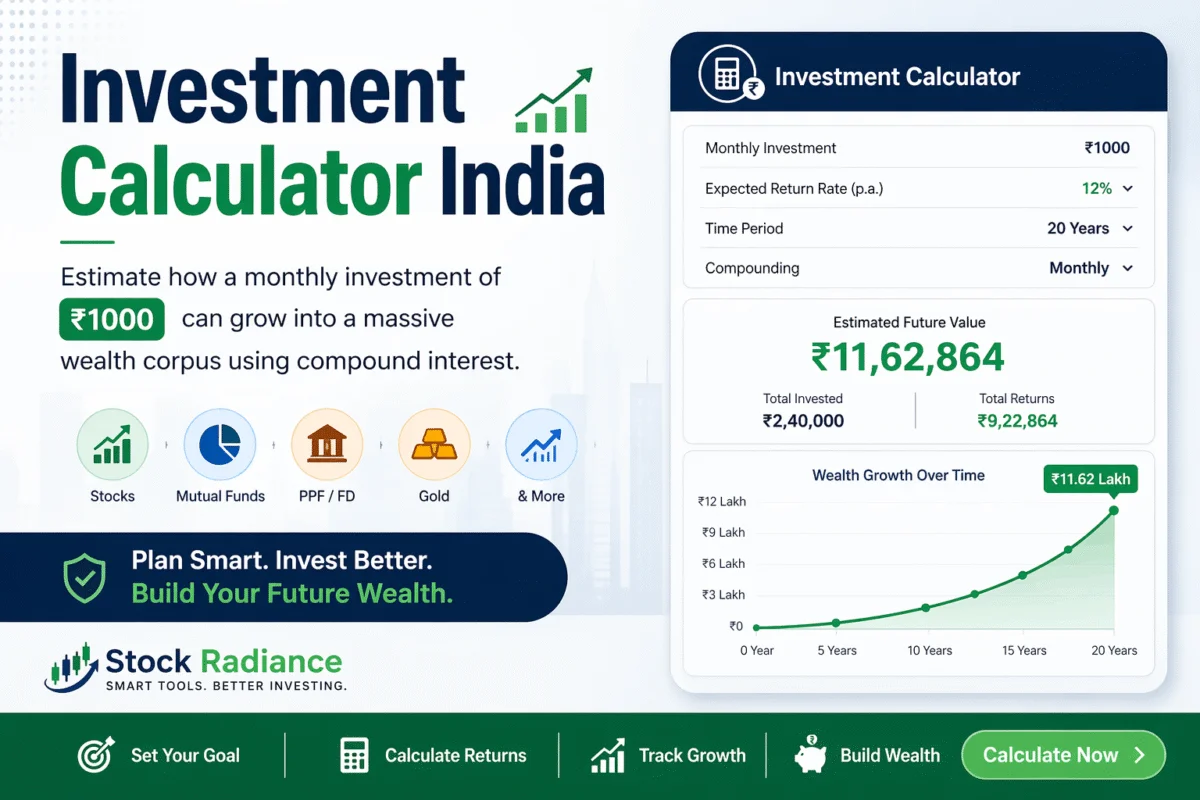
Investment Growth Calculator (₹ INR)
Investment Result
Total Investment: ₹ 0
Total Interest Earned: ₹ 0
Final Value: ₹ 0
📈 Investment Calculator Online India (₹) – Estimate Your Future Investment Value
An Investment Calculator Online India helps you estimate how your money could grow over time. You can enter your starting investment, monthly contribution, expected annual return and investment period to understand a possible future value.
This tool can be useful for planning long-term goals such as retirement, education, a house down payment or general wealth building. The result is an estimate based on the numbers you enter, not a guaranteed future return.
Even a relatively small monthly investment can become meaningful over a long period when returns are reinvested and compounding takes place. The original calculator concept also focuses on initial investment, monthly contributions, return rate and investment duration.
📊 What Is an Investment Calculator?
An investment calculator is a financial planning tool that estimates the potential future value of an investment.
Depending on the calculator setup, you can consider:
- Initial investment amount
- Monthly investment or contribution
- Expected annual return
- Investment period
- Compounding effect
The calculator combines these inputs to show how your investment may grow over time. It is especially useful when comparing different investment amounts and time periods.
⚙️ How the Investment Calculator Works
The basic idea behind long-term investment growth is compounding. When investment gains remain invested, future growth can occur on both the original amount and previously accumulated gains.
For a simple annual compounding calculation, the future value can be represented as:
Future Value = P × (1 + r)t
P = Principal or starting investment
r = Annual return rate in decimal form
t = Investment period in years
When regular monthly contributions are included, the calculation also considers the timing and number of those contributions. Therefore, the final value can differ depending on the exact calculator methodology and compounding assumptions.
For planning purposes, it is useful to test more than one return assumption rather than relying on a single expected return.
🧮 Investment Calculator Example
Consider a simple example:
- Starting Investment: ₹10,000
- Monthly Investment: ₹1,000
- Illustrative Annual Return: 12%
- Investment Period: 10 years
Your total amount contributed over 10 years would be:
At an assumed 12% annual return, the estimated future value would be around ₹2.4 lakh, depending on the exact timing and compounding method used by the calculator.
This example is only for understanding the effect of regular investing and compounding. A 12% return should not be treated as a guaranteed or expected return for every investment.
🌱 Why Use an Investment Calculator Online?
Understand Long-Term Growth
You can see how changing the investment period may affect the estimated future value of your money.
Compare Monthly Investment Amounts
Try different monthly contributions to understand how increasing or decreasing your investment amount changes the projection.
Plan Financial Goals
You can use the calculator while planning long-term goals such as retirement, education, home purchase or other major financial requirements.
Understand the Effect of Time
Longer investment periods can give compounding more time to work. However, the actual outcome depends on investment returns, costs, taxes and market conditions.
🎯 Investment Calculator for Different Financial Goals
🏖️ Retirement Planning
Estimate how your current savings and regular contributions could potentially grow before retirement. You can also compare the result with your expected future expenses.
👉 Read this: Retirement Calculator
🏠 Home Down Payment
If you are saving for a home, the calculator can help you estimate the potential value of money set aside over several years.
👉 Read this: Home Loan Calculator
📚 Education Planning
Long-term education goals can involve rising costs. Combining an investment projection with an inflation estimate can give you a broader planning picture.
👉 Read this: Inflation Calculator
💰 Wealth Building
You can compare different monthly contribution levels and time periods to understand how consistency may affect a long-term investment projection.
🇮🇳 Popular Investment Options in India
Different investment products have different risk, return, liquidity, tax and time-horizon characteristics. An investment calculator should therefore be used as a planning tool rather than as a reason to choose a particular product.
📈 Stocks
Stocks represent ownership in companies and their market prices can fluctuate significantly. Investors should consider business fundamentals, valuation, market conditions and risk before investing.
👉 Read this: Technical Analysis
📊 Mutual Funds
Mutual funds pool money from investors and invest according to the fund’s stated strategy. Returns are market-linked for market-based funds and are not guaranteed.
🏦 Fixed Deposits
Fixed deposits are different from market-linked investments because the interest structure is defined by the bank or financial institution under the applicable terms.
🏛️ Government and Other Fixed-Income Products
Some investors also consider government-backed or other fixed-income products depending on their goals, liquidity requirements and risk preferences.
Always check the current product terms, interest rates, taxation and applicable rules before investing.
🚀 Step-Up Investment Strategy
A step-up approach means increasing your regular investment when your income increases.
For example, someone investing ₹5,000 per month could increase the amount periodically instead of keeping the contribution unchanged for many years.
The advantage is not that a fixed percentage increase will always produce a particular wealth outcome. Rather, increasing contributions can increase the total amount invested over time.
Use the calculator with different monthly amounts to compare these scenarios.
⏳ Why Time Matters in Investing
Time can have a major effect on compound growth because investment gains may themselves remain invested.
For example, instead of asking only, “How much should I invest?”, consider three questions:
- How much can I invest regularly?
- How long can I stay invested?
- What range of returns is reasonable for the investment I am considering?
Testing several scenarios can give a more realistic picture than using only one return assumption.
📉 Investment Returns vs Inflation
A future investment value should not be viewed in isolation. Inflation can reduce the purchasing power of money over time.
For example, ₹10 lakh received many years from now may not have the same purchasing power as ₹10 lakh today.
That is why long-term planning should consider both the potential investment value and future cost of living.
👉 Read this: Inflation Calculator
🧠 How to Use the Investment Calculator
- Enter your initial investment amount.
- Enter the amount you plan to invest regularly.
- Enter an annual return assumption.
- Choose your investment period.
- Check the estimated future value.
- Compare the result with your total contributions.
- Try a shorter investment period.
- Try a longer investment period.
- Test a lower return assumption.
- Test a higher return assumption for comparison only.
- Increase the monthly contribution and compare the difference.
- Use the result as a planning estimate rather than a promise of future returns.
🔍 What Can Change Your Actual Investment Result?
The actual value of an investment can differ from a calculator projection because real-world investing involves factors that a simple calculator may not fully capture.
- Market volatility
- Changes in investment returns
- Investment costs and expenses
- Taxes
- Inflation
- Changes in monthly contributions
- Withdrawals during the investment period
- Changes in asset allocation
- Timing of investments
For this reason, calculator results should be treated as estimates based on assumptions.
⚠️ Common Investment Planning Mistakes
Expecting Fixed Returns
Market-linked investments do not provide a fixed future return. Avoid treating an assumed calculator return as a guaranteed result.
Ignoring Inflation
A future corpus should be considered along with the future purchasing power of money.
Investing Without an Emergency Reserve
Before committing money to long-term investments, consider your short-term liquidity needs and emergency requirements.
Stopping Because of Short-Term Market Moves
Short-term market movements can be unpredictable. Your investment strategy should match your financial goal and risk tolerance.
Using Only One Return Scenario
Testing multiple scenarios can help you understand how sensitive the projection is to the return assumption.
🛡️ Risk Management While Investing
Investment planning is not only about calculating a future number. It is also about understanding risk.
- Match the investment with your time horizon.
- Understand the risks of the product before investing.
- Avoid putting all your money into one asset without considering diversification.
- Keep appropriate liquidity for near-term needs.
- Review your financial plan periodically.
- Consider taxes and investment costs when comparing outcomes.
For market-related research, you can explore the StockRadiance tools below.
👉 Read this: Stock Radar Tool
👉 Read this: Top 50 Stocks
👉 Read this: Sector Dashboard
📚 More StockRadiance Financial Tools
Investment planning often works better when several calculations are considered together.
- Compound Interest Calculator
- Inflation Calculator
- Retirement Calculator
- EMI Calculator
- Home Loan Calculator
- All Finance Tools
🌐 Useful Official & Educational Resources
For current market and regulatory information, use reliable primary sources.
- SEBI – Securities market regulations and investor information
- NSE India – Indian market information
- BSE India – Market and company information
- Reserve Bank of India – Banking and monetary information
- Income Tax Department – Current tax information
- Investopedia – General financial education
Frequently Asked Questions – Investment Calculator Online India
▶ What is an Investment Calculator?
▶ Is the Investment Calculator result guaranteed?
▶ Can I use the calculator for monthly investments?
▶ What is the difference between a lump-sum and monthly investment?
▶ What return rate should I enter?
▶ How does compounding affect investment growth?
▶ Can I use this calculator for retirement planning?
▶ Does inflation affect my future investment value?
▶ Can I increase my monthly investment over time?
▶ Does the calculator include taxes and investment charges?
▶ Is investing in the stock market risky?
▶ Why should I compare different investment scenarios?
🎉 Thank You for Using the StockRadiance Investment Calculator!
We hope this Investment Calculator Online India helps you understand your potential investment growth and plan your financial goals more clearly.
Try different investment amounts, time periods and return assumptions to explore different scenarios.
Final Thoughts
An Investment Calculator is a useful starting point for understanding how regular investing, time and compounding can affect a potential future value.
Instead of focusing on one projected number, use the calculator to compare different scenarios and understand how your assumptions affect the outcome.
Whether you are starting with ₹1,000, ₹5,000 or a larger amount, consistent financial planning and an investment approach that matches your goals can help you make more informed decisions.
👉 Read this: Explore All StockRadiance Finance Tools
Disclaimer: This calculator is provided for educational and planning purposes only. Calculated values are estimates based on the inputs and assumptions used. Actual investment returns, taxes, charges and final values may differ. Market-linked investments are subject to market risks. Please review the relevant product documents and consider professional financial advice where appropriate.
Contents
- 1. Investment Growth Calculator (₹ INR)
- 2. 📈 Investment Calculator Online India (₹) – Estimate Your Future Investment Value
- 3. 📊 What Is an Investment Calculator?
- 4. ⚙️ How the Investment Calculator Works
- 5. 🧮 Investment Calculator Example
- 6. 🌱 Why Use an Investment Calculator Online?
- 7. 🎯 Investment Calculator for Different Financial Goals
- 8. 🇮🇳 Popular Investment Options in India
- 9. 🚀 Step-Up Investment Strategy
- 10. ⏳ Why Time Matters in Investing
- 11. 📉 Investment Returns vs Inflation
- 12. 🧠 How to Use the Investment Calculator
- 13. 🔍 What Can Change Your Actual Investment Result?
- 14. ⚠️ Common Investment Planning Mistakes
- 15. 🛡️ Risk Management While Investing
- 16. 📚 More StockRadiance Financial Tools
- 17. 🌐 Useful Official & Educational Resources
- 18. 🎉 Thank You for Using the StockRadiance Investment Calculator!


